Coffee Grind Size Chart: Every Brew Method Covered
Grind Size Is the Most Underrated Variable in Coffee
Most people buying good coffee are still grinding it wrong.
They’ll spend $20–$30 on quality beans, then run them through a cheap blade grinder on the same setting they use for everything, and wonder why the coffee tastes bitter, flat, or sour.
Grind size controls extraction speed. Too fine, and water spends too long in contact with the grounds, pulling bitter compounds into your cup. Too coarse, and water rushes past before extracting the good stuff, leaving the coffee thin and sour.
As James Hoffmann puts it in The World Atlas of Coffee: grinding the beans exposes more surface area to the air, which means coffee goes stale faster — so it should ideally only be ground just before brewing. That alone is reason enough to own a grinder.
Every brewing method has an ideal grind size. Once you understand why, you’ll never go back to guessing.
How Extraction Actually Works
When hot water hits ground coffee, it dissolves soluble compounds out of the bean: acids, sugars, oils, and bitter compounds. The order matters: acids and sugars extract first (they’re water-soluble and fast), bitter compounds extract last (they take longer).
Research since the 1960s has established that a good cup of coffee extracts 18–22 percent of the ground coffee’s weight. Anything below that range tastes sour and thin (under-extracted). Anything above tastes bitter and ashy (over-extracted).
Grind size controls how fast this happens:
- Fine grind = more surface area = faster extraction = reaches bitter zone sooner
- Coarse grind = less surface area = slower extraction = needs longer contact time
This is why a French press (4-minute steep) needs coarse grounds, while espresso (25-second shot) needs very fine grounds. Same logic, opposite ends of the spectrum.
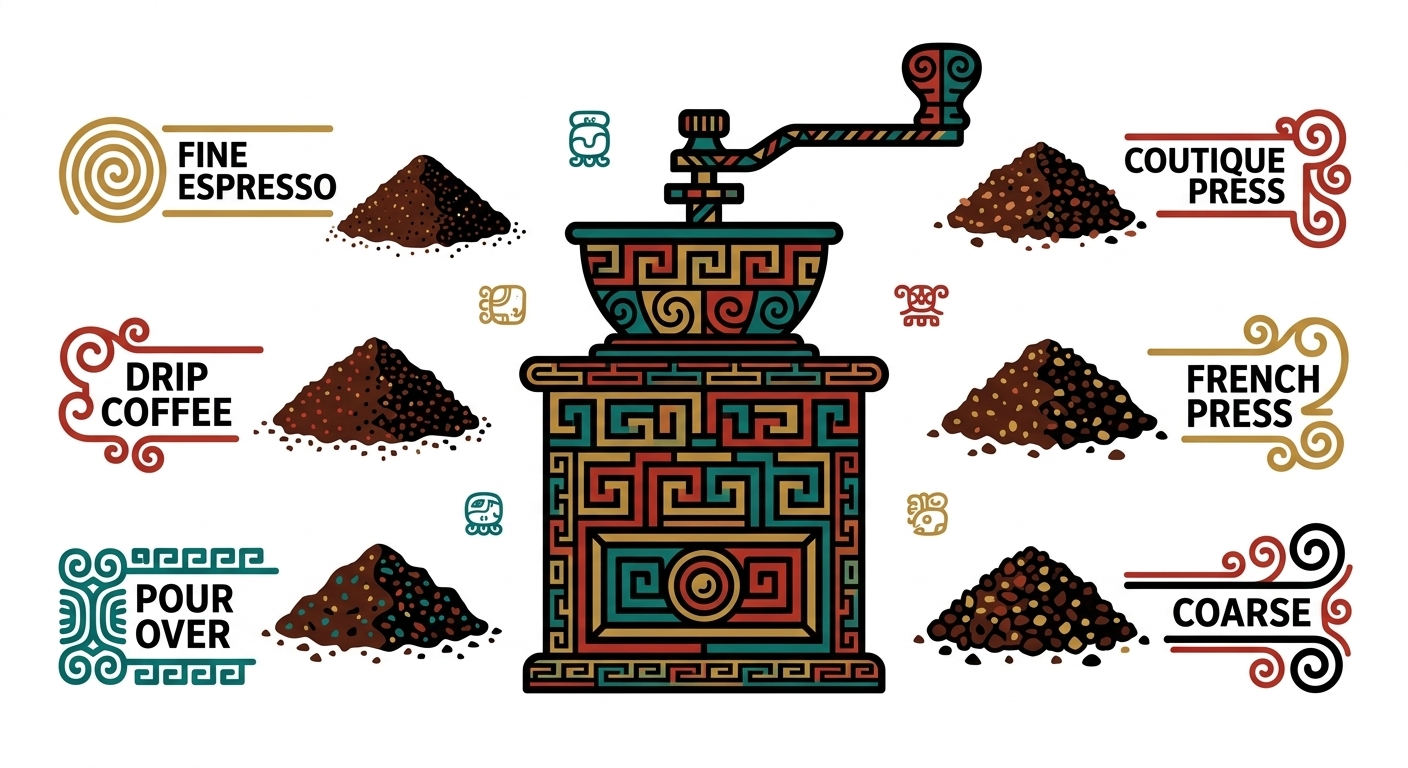
The Complete Grind Size Chart
| Grind | Texture Reference | Brew Method |
|---|---|---|
| Extra Fine | Flour or powdered sugar | Turkish coffee |
| Fine | Table salt | Espresso, moka pot |
| Medium-Fine | Fine sand | Pour over (V60, Chemex), Aeropress |
| Medium | Rough sand / beach sand | Drip coffee makers, flat bottom brewers |
| Medium-Coarse | Rough sea salt | Clever dripper, Chemex with long brew |
| Coarse | Coarse sea salt, breadcrumbs | French press, cold brew |
| Extra Coarse | Rough pebbles | Cold brew (very long steep) |
When in doubt, match the grind to the texture reference. Pick up a pinch of your ground coffee and rub it between your fingers. Does it feel like the texture it should? That’s your quickest quality check.
Grind Size by Brew Method
Espresso: Fine
Espresso forces water through tightly packed grounds at 9 bars of pressure in about 25 seconds. This demands a fine grind so that the pressure has enough resistance to slow the water down for proper extraction.
Espresso is the most grind-sensitive method. Dialing in espresso means making tiny grind adjustments — variations of a few hundredths of a millimetre make a difference — until the shot runs at the right speed. If you’re pulling espresso at home, you need a burr grinder specifically designed for that level of precision.
Moka Pot: Fine to Medium-Fine
The moka pot is a stovetop brewer that uses steam pressure (not as high as espresso) to push water through the grounds. It works best with a fine-to-medium-fine grind, finer than pour over, not quite as fine as espresso.
Avoid packing the basket too tightly. The moka pot needs some airflow to work.
The Bialetti Moka Express has been the standard since 1933 — and pairs especially well with dark roasts like our Kukulkan.

Bialetti Moka Express 6-Cup
Rich, full-bodied stovetop coffee — the Italian way since 1933.
Approximate price · Check current price on Amazon
Pour Over (V60, Chemex, Kalita): Medium-Fine
Pour over uses gravity. Water flows through the grounds at a pace controlled by the grind size and the filter. Medium-fine is the sweet spot: water drains at a steady speed, giving 2:30–3:30 of total brew time. See our full pour over guide for the complete step-by-step technique.
Go too coarse and your brew rushes through in under 2 minutes (under-extracted, sour). Too fine and it chokes, taking 5+ minutes (over-extracted, bitter).
The dripper you choose also matters. The Hario V60 is the most widely used pour over in specialty coffee — spiral ribs create airflow between filter and wall, giving you complete control over the pour.

Hario V60 Dripper 02
The pour over dripper used by more specialty cafes than any other.
Approximate price · Check current price on Amazon
Drip Coffee Maker: Medium
Most automatic drip machines are calibrated for a medium grind. This is the most forgiving grind range. A little coarser or finer still produces a decent cup, which is why drip coffee is so easy.
If your drip coffee tastes weak or sour, grind finer. If it tastes bitter, grind coarser.
Aeropress: Medium-Fine to Medium
Aeropress is the most versatile brewer in terms of grind size. Because you control brew time, temperature, and pressure manually, you can dial it in any way you like.
Start at medium-fine for a 1:30–2:00 brew time. Adjust from there.

AeroPress Original
Espresso-like concentrate or clean filter coffee — in 60 seconds.
Approximate price · Check current price on Amazon
French Press: Coarse
French press is full-immersion brewing: grounds sit in hot water for 4 minutes before being separated by the plunger’s metal mesh. A coarse grind is essential. For the full technique, ratios, and troubleshooting, see our French press guide.
Fine grounds steep too quickly and extract too much bitterness. They also slip through the mesh, giving you a gritty, muddy cup. Coarse grounds extract at the right pace and stay above the plunger.
Target: rough sea salt or breadcrumb texture.

Bodum Chambord French Press
The French press that defined the category — and still the best value.
Approximate price · Check current price on Amazon
Cold Brew: Coarse to Extra Coarse
Cold brew steeps in cold or room-temperature water for 12–24 hours. The long steep time demands a very coarse grind to avoid over-extraction. With fine grounds and a 12-hour steep, you’d get a cup so bitter it would be undrinkable.
Use your coarsest grind setting and steep 12–18 hours in the fridge.
Burr Grinder vs Blade Grinder
This is where most home coffee drinkers lose quality before the water even heats up.
Blade grinders chop coffee with a spinning blade, like a food processor. The problem: they produce an inconsistent mix of large chunks and fine powder. That mixture extracts at wildly different rates simultaneously. Fine particles go bitter, coarse chunks stay sour, and the cup ends up tasting confused.
Burr grinders crush coffee between two rotating surfaces (burrs) set at a precise distance. Every particle comes out nearly the same size. Because the grounds can’t escape until they’ve been cut down to the size of the gap between the burrs, the resulting grounds are very even. Even extraction, balanced flavor, consistent results.
You don’t need to spend a lot. A hand burr grinder for $40–$60 produces dramatically better results than any blade grinder at any price. If you’re making pour over or French press and you haven’t switched to a burr grinder yet, this is your highest-impact upgrade. A grinder also makes an excellent gift for any coffee lover.
Best Hand Grinder: Under $60
The Timemore C2 Max is the sweet spot. Stainless steel burrs, 36 grind settings, and it grinds 20g in about 30 seconds. At this price, there is no good reason to use a blade grinder.

Timemore Chestnut C2 Max
The hand grinder that made burr grinding affordable without sacrifice.
Approximate price · Check current price on Amazon
Best Hand Grinder: Under $100
If you want even more precision and faster grinding, the 1Zpresso JX uses 48mm burrs that produce competition-level uniformity.

1Zpresso JX
Competition-level hand grinder at a fraction of the price.
Approximate price · Check current price on Amazon
Best Electric Grinder: Home Use
For electric, the Baratza Encore ESP is the one coffee professionals recommend to beginners. Hoffmann himself calls it the best entry-level electric grinder. 40 settings from espresso to French press, and Baratza sells every replacement part so it lasts for years.

Baratza Encore ESP
The electric burr grinder coffee professionals recommend to beginners.
Approximate price · Check current price on Amazon
Grinder Comparison
| Feature | Timemore C2 Max | 1Zpresso JX | Baratza Encore ESP |
|---|---|---|---|
| Type | Manual | Manual | Electric |
| Price | $55.90 | $79.99 | $169.95 |
| Burr Size | 38mm steel | 48mm steel | 40mm conical |
| Grind Settings | 36 clicks | 90+ clicks | 40 steps |
| Best For | Pour over, French press | Pour over, French press | All methods inc. espresso |
| Speed (20g) | ~30 seconds | ~25 seconds | ~10 seconds |
| Travel-Friendly | Yes | Yes | No |
How Grind Size Affects Each Origin Differently
Not all coffees respond to grind adjustments the same way. Higher-grown, denser beans (like Honduran high-altitude coffees) extract slightly more slowly than lower-grown, less dense beans. You may find that a Honduran light roast requires a slightly finer grind than you’d use for a Colombian medium roast at the same brew method.
This is one reason specialty coffee from high-elevation origins like Honduras’s Copan and Marcala regions can taste noticeably different from supermarket coffee at the same grind setting, because the bean density changes the extraction behavior. Hoffmann notes in his Honduras chapter that Copan coffees are grown at 1,000–1,500m and Marcala (a protected name) at 1,200–1,600m — both altitudes that produce dense, hard beans requiring careful grind attention.
Dialing In: A Simple Method
When you try a new coffee or a new method, use this process:
- Start at the recommended grind for your method
- Brew and taste
- Sour or weak? Grind finer (more extraction)
- Bitter or harsh? Grind coarser (less extraction)
- Adjust one step at a time until you hit balance: sweet, clean, and full
Once you find the right setting for a particular coffee and method, write it down. Grinder settings are not universal. “Setting 7” on one grinder isn’t the same as “setting 7” on another.
A kitchen scale helps enormously here. Weighing your coffee (rather than scooping) removes one variable so you can isolate grind size changes more clearly.

Greater Goods Coffee Scale
The budget scale that coffee Reddit actually recommends.
Approximate price · Check current price on Amazon
Which Coffee to Start With
If you’re dialing in grind for the first time, start with a medium roast. Light roasts are more grind-sensitive (especially to under-extraction) and dark roasts can mask mistakes with intensity. A medium roast gives you the clearest feedback on whether you’re extracting correctly.
Our Balam medium roast is ideal for this. Its toasted almond and brown sugar notes are distinct enough that you’ll hear them clearly when the extraction is right. It performs well across drip, pour over, and French press at their respective grind settings.
For pour over specifically, our Mut light roast shows you the full range of what grind adjustment can do. Get it right and you’ll taste jasmine and stone fruit; get it wrong and it tastes flat. That feedback loop teaches grind faster than anything.
For French press, Kukulkan dark roast is forgiving of small coarseness variations while clearly punishing a grind that’s too fine.
Go Deeper
If you want to understand the science behind grinding, extraction, and brewing at a deeper level, James Hoffmann’s The World Atlas of Coffee dedicates full chapters to grinding, water chemistry, and brewing basics. It’s the single best reference book for anyone serious about making better coffee at home.

The World Atlas of Coffee
The definitive guide to coffee — from bean to cup, country by country.
Approximate price · Check current price on Amazon
Frequently Asked Questions
What grind size for French press? Coarse, like rough sea salt or rough breadcrumbs. This is the most common grind mistake: people grind too fine and get bitter, gritty coffee.
What grind size for pour over? Medium-fine, like table salt or fine sand. Aim for a total brew time of 2:30–3:30. If it drains faster, grind finer. Slower, grind coarser.
What grind size for drip coffee? Medium, like beach sand. Most automatic drip machines are calibrated for this.
Does grind size matter for cold brew? Yes, use a very coarse grind. Cold brew steeps for 12–24 hours, so a fine grind would massively over-extract and turn bitter.
Is a burr grinder worth it? Absolutely. Even a $40 hand grinder will outperform a blade grinder at any price. Consistent particle size is the foundation of good extraction.
Why does my coffee taste different every time even with the same setting? Most likely your grind is slightly different due to bean moisture or roast level changes between bags. Dial in fresh with each new bag rather than assuming the same setting will carry over.
The right grind starts with the right beans. Shop Balam Medium Roast.