Kukulkan: The Feathered Serpent God of the Maya
Who Was Kukulkan?
Kukulkan was the Feathered Serpent, one of the most revered and feared gods in all of Mesoamerican religion. His name comes from the Yucatec Mayan words k’uk’ (quetzal feather) and kaan (serpent). Together: feathered serpent. The name Kukulkan literally means “feathered serpent” in the Mayan language.
He was known by different names across Mesoamerica. The Aztecs called him Quetzalcoatl. The Toltecs worshipped him as a warrior-god who brought civilization. But to the Maya, Kukulkan was the supreme creative force: the deity who bridges sky and earth, who brings rain to the crops, who keeps the seasons in motion.
Without Kukulkan, there would be no rain. Without rain, no maize. Without maize, no life.
Kukulkan in Mayan Cosmology
The Maya believed the world was created through a series of cosmic acts, and Kukulkan was central to all of them. The Feathered Serpent appears in the Popol Vuh, the Mayan creation story, as Gucumatz, one of the creator gods who shaped the earth from water and brought humans into being.
The Popol Vuh is the single most important surviving text from the ancient Maya world, and Kukulkan — under his K’iche’ name Gucumatz — is one of its central figures. Reading it firsthand is the best way to understand what creation meant to the Maya.

Popol Vuh: The Definitive Edition
The Mayan creation story — the Hero Twins, the gods, the origin of humanity.
Approximate price · Check current price on Amazon
Kukulkan represented the union of opposites: the serpent (earth, water, underworld) combined with the quetzal bird (sky, wind, heaven). This made him the ultimate bridge between worlds, a cosmic figure who could move through earth, sea, and sky with equal power.
He was associated with:
- Wind and storms: he breathed life into the world through the wind
- Rain and water: essential for crops in the seasonal tropics
- Venus: the morning star, which the Maya tracked with extraordinary precision
- Time and calendars: Kukulkan was connected to the 365-day Haab calendar and the 260-day Tzolkin
- Creation itself: the force that shaped the cosmos
What Does Kukulkan Look Like?
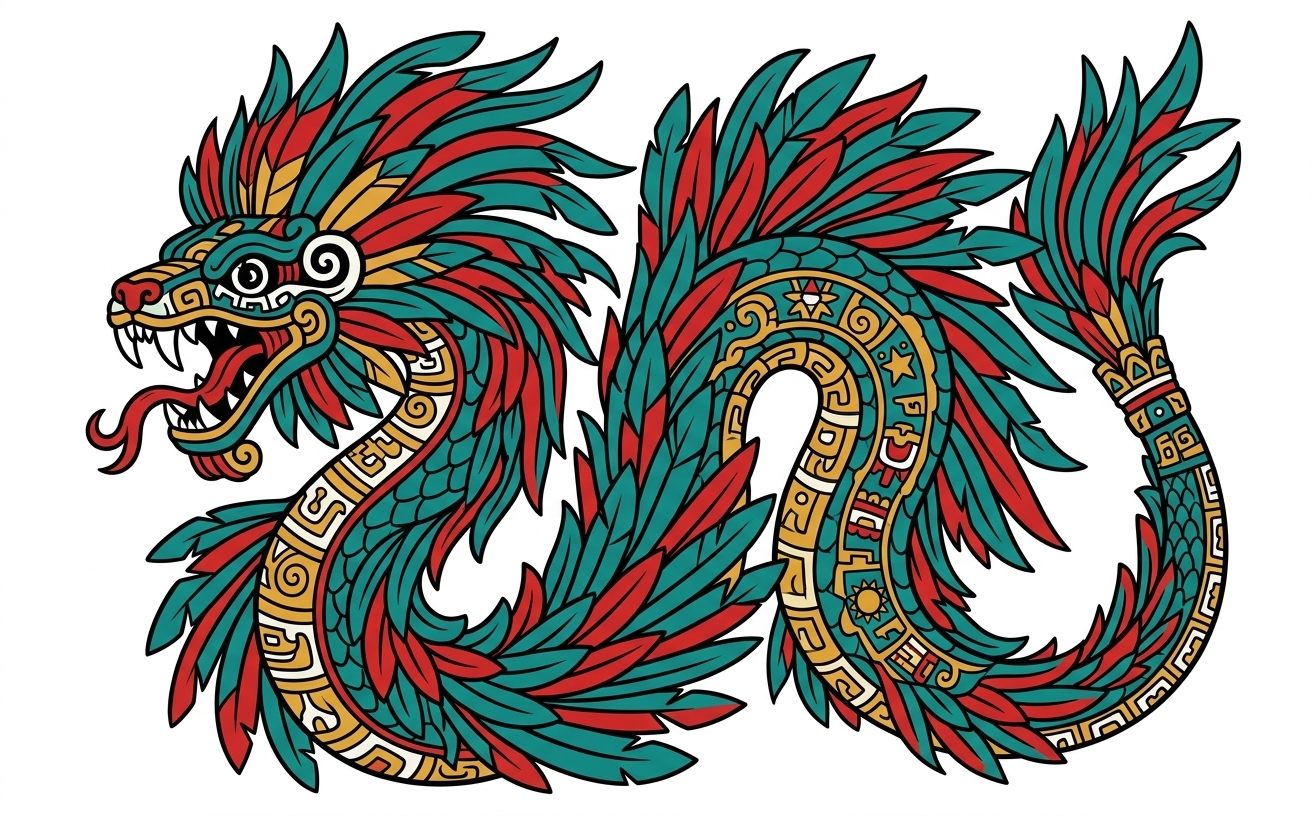
Kukulkan’s appearance is one of the most distinctive in Mayan art. He was depicted as a massive serpent covered in the brilliant green feathers of the quetzal bird, one of the most sacred animals in Mesoamerica. In stone carvings, his body coils and undulates, scales and plumage merging into a single form.
At Chichen Itza, giant stone serpent heads with open jaws and exposed fangs guard the base of El Castillo. In painted ceramics and the surviving Mayan codices, Kukulkan sometimes appears in human form: a figure wearing an elaborate serpent headdress with feathers cascading from the crown, or a human face emerging from the open mouth of a feathered snake.
The feathered serpent was a deliberate paradox. Serpents crawl on the ground; birds fly in the sky. Combining them into a single creature expressed Kukulkan’s role as the god who unites earth and heaven, the visible and the invisible, the mortal and the divine.
Kukulkan at Chichen Itza
The most famous monument to Kukulkan is El Castillo, the pyramid at Chichen Itza in the Yucatán, Mexico. The Maya built it so that twice a year, during the spring and fall equinoxes, sunlight creates the shadow of a serpent descending the northern staircase.
As the sun moves across the sky over several hours, triangles of light and shadow form along the pyramid’s edge, creating the illusion of a feathered serpent slithering down toward the ground. The effect lasts precisely 34 minutes.
The Maya engineered this deliberately, over 1,000 years ago. No accident, no approximation. Exact astronomical calculation built into stone. Every year during the equinox, tens of thousands of people still gather at Chichen Itza to watch Kukulkan descend.
Kukulkan and the Venus Cycle
The Maya were among the greatest astronomers of the ancient world. They tracked the movements of Venus with exceptional precision, and Kukulkan was their Venus deity.
Venus completes one full cycle, from morning star to evening star and back, in approximately 584 days. The Maya tracked this cycle and aligned their ceremonial calendar with it. When Venus appeared as the morning star, Kukulkan was believed to be present: a time for ritual, for warfare, and for major decisions.
The Dresden Codex, one of only four surviving Mayan books, contains detailed Venus tables used to predict Kukulkan’s appearances centuries into the future. The precision of Mayan astronomy, built entirely with naked-eye observation, still astonishes astronomers today.
For the full archaeological story of the feathered serpent across Mesoamerica, Michael Coe’s The Maya remains the definitive introduction.

The Maya (9th Edition)
The most respected introduction to Mayan civilization in print.
Approximate price · Check current price on Amazon
The Feathered Serpent Across Mesoamerica
Kukulkan’s influence extended far beyond the Maya world. At Teotihuacan (near modern Mexico City), the Temple of the Feathered Serpent was built around 200 CE, predating the height of Maya civilization. At Tula, the Toltec capital, Quetzalcoatl presided as patron deity.
This cross-cultural sharing of the Feathered Serpent figure points to deep connections between Mesoamerican civilizations. Traders, priests, and warriors carried this story across thousands of miles of jungle, highland, and desert.
Michael Coe’s Breaking the Maya Code reads like a thriller — the decades-long quest to decipher the inscriptions Kukulkan’s priests left behind.

Breaking the Maya Code
The detective story of how scholars cracked the Mayan hieroglyphs.
Approximate price · Check current price on Amazon
Mark Pendergrast’s Uncommon Grounds traces how coffee reshaped the same Central American highlands where Kukulkan was worshipped.
Uncommon Grounds: The History of Coffee
The full history of coffee — from Ethiopian legend to global commodity.
Approximate price · Check current price on Amazon
The feathered serpent wasn’t just a god. It was an idea: that power and grace can exist in the same being. That what flies and what crawls can be one.
Kukulkan and Our Dark Roast Coffee
We named our dark roast after Kukulkan because of his commanding power. He was the serpent that flies, the god that bridges earth and sky, the destroyer and creator in one.
Our Kukulkan dark roast reflects that intensity: dark chocolate, smoky cedar, dried cherry. Bold and purposeful. A coffee for those who drink with intention.
Grown in the highlands of Copán, Honduras at 1,300–1,700 meters above sea level, washed process. The same mountains where Mayan civilization flourished for centuries produce this coffee today, and it carries that weight in every cup.
For the full story of Kukulkan’s place alongside the other great gods of the Maya world, see our complete guide to the Mayan deities.
If Balam is balanced power — named for the jaguar god of the Maya — and Mut is luminous clarity, Kukulkan is something else entirely. It’s the coffee you drink when you mean business.
Our Kukulkan dark roast was built for intensity. A Moka pot concentrates that dark chocolate and smoky cedar into something close to espresso.

Bialetti Moka Express 6-Cup
Rich, full-bodied stovetop coffee — the Italian way since 1933.
Approximate price · Check current price on Amazon
Frequently Asked Questions
Is Kukulkan the same as Quetzalcoatl? They share the same origin: the Feathered Serpent deity that appears across Mesoamerican cultures. Kukulkan is the Mayan name, Quetzalcoatl is the Aztec/Nahuatl name. The imagery and symbolism are closely related but differ by region and period.
What does Kukulkan look like? Kukulkan is depicted as a serpent covered in quetzal feathers, often with a human face emerging from its mouth. At Chichen Itza, his stone heads appear at the base of El Castillo’s staircases, massive fanged serpent heads marking the boundary between earth and underworld.
Why did the Maya build pyramids for Kukulkan? Pyramids served as mountains, artificial sacred mountains that connected earth and sky. El Castillo’s equinox shadow effect demonstrated Kukulkan’s presence and power on specific astronomical dates. The pyramid was a calendar built in stone.
Where is Kukulkan coffee grown? Our Kukulkan dark roast is grown in the highlands of Copán, Honduras, the heart of Mayan territory in Central America, at 1,300–1,700 meters above sea level.
Taste the power of Kukulkan. Shop our dark roast.